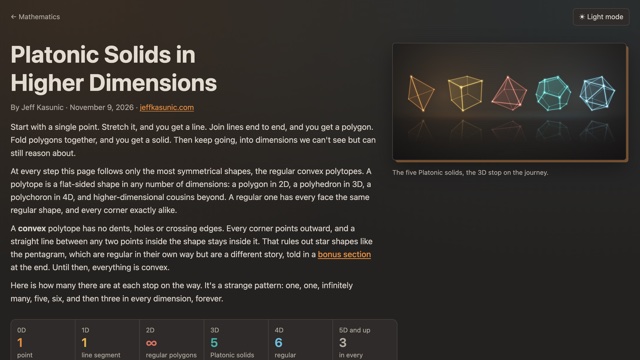
The five Platonic solids as glowing wireframes, from left to right a tetrahedron, cube, octahedron, dodecahedron, and icosahedron, reflected on a dark floor
The five Platonic solids, from my interactive summary of the regular polytopes.

Mathematics

I study multi-dimensional geometry: what shapes look like in four or more spatial dimensions, and how we can learn to see them from down here in three.

It grew naturally out of my work in computer graphics. Lighting and rendering is already about projecting a 3D world onto a 2D image, so asking what a 4D world would look like projected into 3D felt like the next question to ask.

Seeing in higher dimensions

What Draws Me In

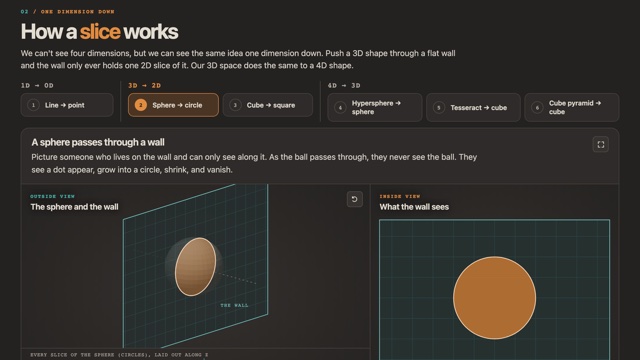
I'm fascinated by hidden structures: things human brains can't picture, yet mathematics can describe them exactly, and that math reaches into our three-dimensional world. We can't see a fourth spatial dimension directly, but we can reason about it by analogy, the way a flat creature in Edwin Abbott's Flatland might reason about our three.

A few of the ideas I keep coming back to:

Slicing

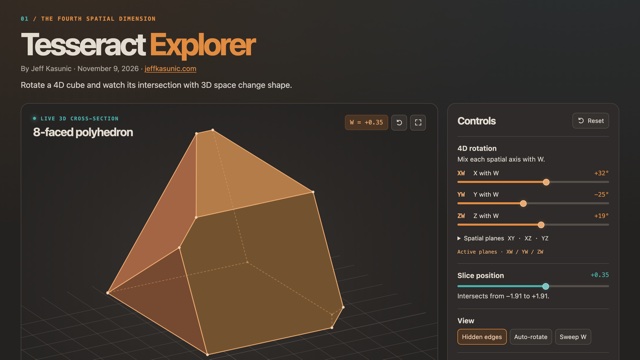
A sphere passing through a plane appears as a circle that grows and shrinks. A 4D object passing through our space would do the same thing in 3D. Slice a tesseract corner-first and the cross-section begins as a tetrahedron and swells into an octahedron at the middle.
Projecting

A cube's shadow on a wall is a 2D picture of a 3D object. The familiar "cube within a cube" is the same trick one dimension up: a 3D shadow of a 4D hypercube.

Rotating

In 3D we rotate around an axis, but rotation really happens in a plane. Four dimensions have six of them (XY, XZ, XW, YZ, YW, ZW), and rotations that involve W turn a shape "inside out" in ways that have no 3D counterpart.

Counting

A tesseract has 16 vertices, 32 edges, 24 square faces, and 8 cubic cells, and 16 − 32 + 24 − 8 = 0, just as Euler's formula predicts. There are five Platonic solids in 3D, six regular polytopes in 4D, and only three in every dimension above that.

Platonic Solids in Higher Dimensions

Platonic Solids in Higher Dimensions article, with the five Platonic solids as glowing wireframes and a count of regular polytopes in each dimension

I wrote a guided journey through the regular polytopes, the most symmetrical shapes there are, from a single point up to shapes in eight dimensions.

Hyperslice

Reading about the fourth dimension only goes so far, so I built a tool to explore it. Hyperslice is an interactive geometry lab, and it's also listed with my other Development projects.